
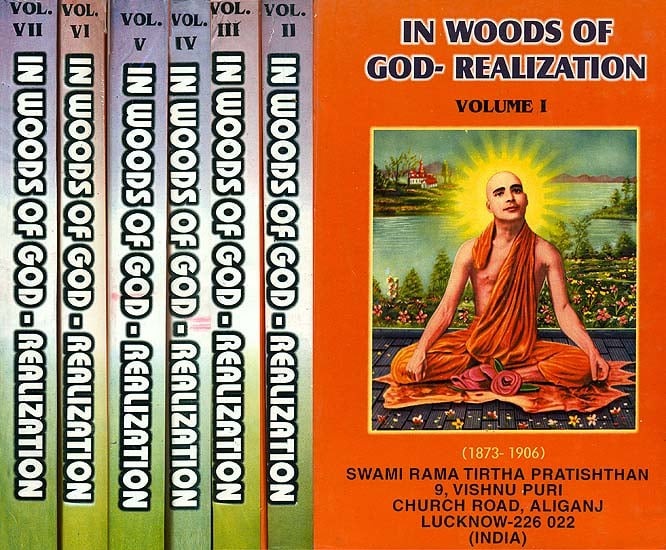

In Woods of God-Realization (Set of VII Volumes)
by Swami Rama Tirtha Pratisthan
Author : Swami Rama Tirtha Pratisthan
Publisher : Swami Rama Tirtha Pratisthan
Language : English
Item Code : SRT002
Pages : 2713
Weight : 3 KG
Dimensions : 21.5 X 14.5 cm
Edition : 2021
Binding : PAPERBACK
Delivery within


Rama lays claim to no mission. All missions are his. He is you and you are he. No Plurality. No Duality. This is the Truth: Rama expounds, Rama lives, Rama sheds, Rama bestows. This realization of Truth can be had by anybody as Truth is nobody's preserve, Truth belongs to one and all. This aspect is bought home by the volumes of 'In Woods of God-realization' in which Rama speaks to us directly from his heart of hearts and lays before us the ideas which he has practically mastered himself. He advises us to accept what he says only when it comes true to the test.
The present volume - the first in the series of 'In Woods of God-Realization', now in its eleventh edition, gives an impetus and inspiration to the readers to tread the path of Truth by themself and not by proxy to know what Truth is. 'To know is to become'. 'Know Truth and become Truth'. This is Vedanta and this is what Rama expresses.
This volume now in the hands of the Truth-seekers removes the mist of ignorance and unfolds 'Real Self' which is home of happiness and the substratum of everything in all the states of the dreamlessness, dream-land and wakefulness. It also unravels the secret of success and tells how to achieve it and become that fountain-head wherefrom Real Power flows continuously and fulfils all desires one may entertain.
Next it also explains, besides other aspects of life, the Law of Life Eternal. It is this law which rules everything conceivable or non-conceivable. This law-the Law of 'Trishul' is very harsh on those who violate it and there is no escape. But those who abide by it are allowed to ride over it and reap the eternal life. It also provides guide-lines for married life and explain what Vedanta stands for.
Since 1909, seven Volumes of 'In Woods of God- Realization' have been published by the Pratisthan. These explain the practicability of Vedanta, which was and is, perhaps," read merely as good food for the intellectual consumption. It is Rama who declares that if Vedanta does not remove your chill; '- if it does not cast off your burden, then kick it aside. He pronounces in unequivocal terms that 'Vedanta printed in books and placed on shelves to be eaten up by worms, would not do. You must live it'.
This living Vedanta is what Rama preached and what Rama lived. There is no other way. This Vedanta may be called by any name one chooses, but the content of Vedanta is eternal and omnipresent. To achieve this content- 'TRUTH', one is to pay the price and without paying the price one cannot have it. The price, Rama explains, is : Denial of little self and Assertion of real self. One may pay this price by continous feeling God-head, Knowing God-head and becoming all-pervading God "सर्व खलविदम् ब्रह्म". Brahman which is omnipresent, omnipotent and omniscient. And ‘That Thou Art’- तत्वमसि.
The Pratisthan hopes that the inquisitive seekers of Truth will be inspired by these Volumes of 'In Woods of God- Realization' in their search and mission. Success is theirs, once they are convinced of Real Self. The only need is to live in Self and roam in the their pristine glory of Divinity. That is Rama's Promise.
Preface To The First Edition
These volumes are presented to the public in the name and memory of Swami Rama. In these volumes it is proposed to bring together all his writings and speeches. A short collection of his articles and essays published in his lifetime has already been reprinted and put before the public in nice form by Messrs. Ganesh and Co., Publishers, Madras. Besides these his other manuscripts, mostly the lecture-notes of his American speeches, taken down by some American friends, were found in his box when he left us for ever.
Excepting the articles referred to above, that were published in his life-time and which also have been included in the present collection, all other lectures have not had the advantage of his revision. So much that he might have eliminated is still there and so much more that he might have added is absent.
He had intended to thoroughly recast, in fact to write anew all the valuable portions of the subject-matter of these manuscripts, with much more that was in his mind, into a systematic exposition of his teachings, a work that must have been a fresh and novel contribution on the philosophy of Vedanta advancing the latter systematically as the individual and social religion of the coming generations.
But his work remained unfulfilled mainly for two reasons, first because about two years before his Samadhi, he seriously and earnestly undertook a thorough and complete study of the Vedas in original as preparation for his proposed work, and thus, I think the time which he could have perhaps more profitably devoted to the systematisation of his own writings was spent in the efforts of making his final work grand and monumental in every way; secondly, living in his beloved solitude of the Himalayas, out of touch with people whose hopes and aspirations might have stimulated his intellect to work for their fulfilment, his mind soared higher and higher till it lost its foot-hold by his daily increasing absorption in the Infinite.
When the writer was for the last time with him, he, kept silent for most of the time. He had ceased taking interest in reading and writing. When questioned, he would expound to us the secrets of his state of consciousness, this supreme silence he called then by the name of Death-in-Life. He would tell us, the more one dies in Life, the greater is the good that naturally and spontaneously comes out of such a man for the benefit of others. "Rama may not seem to finish the task in hand, but Rama knows it will sometime be done all the better when he is gone.
The ideas that saturate Rama's mind and have guided Rama's life, will gradually in the fullness of time filter down to society and can work their destiny properly when Rama loses himself now in the Divine, foregoing all plans, wishes and aims." He had taken to this idea so ardently that no entreaties could prevail upon him to commence writing his work.
Thus, though deprived of the systematic exposition of his teachings by himself, it is a matter of consolation that we. still have with us some of the subject-matter of his thought, however scattered and fragmentary it may be. It has, therefore, been decided, not without some hesitation, that this subject- matter of his thought and the reflections of his consciousness in his extempore speeches, with his essays and note-books, should be put before the public in a printed form, almost in the same form as he left them.
Those that have met Rama personally will recognize him in many and perhaps all of the speeches and will feel as if they were still listening to his wonderfully eloquent character. They will feel enchanted once again by the spell of his personality supplementing as they would all that may be lacking in the printed form by the affectionate and reverent associations of him in their minds. Those that have had no occasion to see him will be able to realize the state of that supremely blissful consciousness which is at the back of these utterances and gives them their charm and meaning, provided they may have the patience to read them through.
They may not be able follow him in some of his ideas at one place but at another place they will find those ideas expressed much more clearly and with greater force. Men of different shades of opinion and thought, on reading through these pages, will find ample food for their thought and spirit, and much that they will surely recognize to be their own. In these volumes, he appears before us by no means as a literary man and has no desire to be judged as an author, but he comes before us with the majesty of a teacher of the spiritual laws of life.
One great feature of his speeches is that he speaks to us directly from his heart and never endeavours to give us a lecture-room demonstration of Vedantic doctrines, not because he was unable to do so- for those who know him, know him to be the master of the subject he is handling but because he is trying to lay before us only those ideas which he practically carried into his own life and which, he thinks, would, if followed by others, guide, as they did in his-case, the like of man to the pinnacle of glory, of happiness and success.
He, therefore, does not lay. before us the intellectual side of his mind, but tries to give us some of his own experiences and speaks out clearly with an inspired enthusiasm of the effects that certain thoughts produce on life when carried into actual practice. As such these speeches are only aids and suggestions to the realization of Truth that he believed in, rather than the philosophical and closely reasoned expositions of that Truth. Are we not already sick of works overloaded with intellect? It is indeed refreshing to see a masterly mind coming home to us in simpler and clearer and commoner accents of life.
Instead of an argument, Swami Rama gives us a story, believing that the actual life of a man sympathises more with the life of another and weighs it more than all the abstract architecture of mental reasoning. There is that airiness and freedom in his expression which characterises the speech of a poet only. Poet-philosopher as he was, the suggestiveness of thought and speech is marvellous, pointing as it does to Infinity. He is the philosopher of that deep music of life which is audible to those only who go deep enough.
A few lines may be appropriately devoted here to give an idea of what Rama was in himself and to us. Born in an ordinary Brahman family in the Punjab, (now in Pakistan) he was the patient architect of himself from childhood to manhood. He built himself little by little, moment by moment, and day by day. It may be said that perhaps the whole career of his future life was sketched already before his mind's eye, because even as a boy he was working so gravely, so silently and so consciously for a definite mission.
There was the resolution of a riper mind in the steps of the poor Brahman boy who faltered, not under any circumstances, and who was never daunted by any difficulties. Under that extremely humble and winsome appearance, touched with resignation and purity almost like that of a shy and modest maid, there was concealed in this thin frame of the Brahman boy an iron will which nothing could shake. He was a typical student who loved to study not with any nope or gaining worldly ends, but for satisfying the ever-growing thirst for knowledge which was firing his soul anew with every new Sun. His daily studies were sanctified oblations on the altar of this havan kund.
He would forego an extra suit to himself, and an extra loaf or even a day's meal for the sake of oil for his midnight lamp to read his books. It was not unoften in his student life that he kept absorbed in his studies from sunset to sunrise. There was that love of knowledge which pulled strongly at his heart so much that the ordinary comforts and physical needs of a student life were entirely forgotten. Hunger and thirst, cold and heat, could not tell upon his supreme passion that he felt towards knowledge.
There are witnesses of his student life still living at Gujranwala and Lahore, (Pakistan) who say that the pure-minded Goswami toiled unarmed and alone day and night, fighting with life without the sinews of war, and they remember the occasions when even in this country of boasted charity, the poor Brahman boy had for many a day little or nothing to eat, though every muscle of his face always exhibited an ineffable joy and satisfaction.
Introduction
I have great pleasure in complying with the request of the friends of .the late Swami Rama Tirtha and writing a brief introduction to the series of lectures contained in this book. The name of Swami Rama is one which I have learnt to honour through residence in the Punjab where his chief influence was felt. Again and again I have seen faces lit up at the mention of his name, and men have told me how much they owed to him. He came at a time when a deep unsettlement was taking place in the minds of educated Indian students with regard to religious truth, and when the claims of the material world were becoming too absorbing.
The training in Western Sciences, divorced as it is in Government institutions from religious culture, inevitably led to an indifference to religion altogether. After college days, the struggle for existence in the world has only too often left little or no opportunity for the cultivation of the inner nature, and a reputation for worldliness had gathered round educated life in the Punjab. The reputation is not altogether justified, for there have been most notable exceptions; but the dangers of the time of transition have been very great and the results serious.
Into such an atmosphere of getting and spending, Swami Rama's unworldly spirit came with a message that commanded attention by its very contrast. No one could be long in his presence without feeling that the highest happiness in life was to be found, not in the things of the body, but in the things of the soul.
It was not so much that anyone had taught him the truths he held so dear (though he would have been the first to acknowledge how much he owed to the kindly influences of the Forman Christian College where he was both a student and a Professor), but he seemed from his earliest childhood, to have grown up with an intense realization of spiritual realities and every instinct in his nature pressed him forward to the devout religious life.
Many of those with whom I have conversed about him have told me of the innate power which he possessed, a power which moved them profoundly whenever they met and talked with him, a power which took their thoughts away from material things and made them feel, if only for a moment, the reality of spiritual experience. The Lectures and Conversations which are now published for the first time, will show more clearly than any words of mine the secret of his great influence.
There is a childlike simplicity in what he writes, and an overflowing joy and happiness, won through great self-discipline and suffering, which reveals a soul that is at peace within itself and has found a priceless gift that it desires to impart to others. There is a striking personality which makes itself manifest in his very language and mode of address. At the same time there is on every page a definite refusal to appeal to those lower motives that are ordinarily urged as making for success in life, and a determination to find in the soul itself, apart from outward circumstances, the secret of all true and lasting joy.
The Lectures unfortunately have not had the revision of the author himself. He would undoubtedly have altered much, and possibly abbreviated much. He would have corrected also the metrical form of some of his poems, which have clearly been put down on paper as the inspiration to write came to him, without any laboured correction. But while there is considerable loss to the reader on this account, there is also considerable gain; for what is lost in finish and correctness is gained in freshness and vitality.
I cannot doubt that the friends of the author were right in tenderly and piously preserving every word of the manuscript before them. The readers will gladly make allowance for repetition and lack of finish, when the individuality of the Swami himself is brought so vividly before them by his manuscript notes. We seem to be talking with him, as we read, and he seems to be talking with us. We feel, the Swami himself still present in his words" and can almost picture him speaking.
If I were asked to point out what I considered to be the special qualities that appear in these writings, I should mention' first and foremost the point I have already emphasised, namely, the unworldliness that is apparent on every page. Wealth, riches, worldly ambitions, luxuries-these are all laid aside without a murmur. The Swami's own life had reached a calm haven, into which the stormy passions, that are roused by the acquisition of wealth and worldly honours, had never come.
His inner life had been free from such things. He cannot even understand them. The child-nature seems to come out in him as he speaks of them. He smiles at them with an almost boyish laughter from his own retreat, or mocks at them with a gentle raillery. The laughter appears most of all in his poems. In the second place I would mention his overflowing charity, his kindliness of spirit, which seems incapable of bitterness or malice. He is always trying to win men, not to drive them; to make the best of them, not to blame or scold them; to attract them by the power of his ideals, not to argue with them in useless and unsatisfying controversy.
The bitter and rancorous spirit is absent and the kindly tolerant spirit prevails. This is especially noticeable when he is dealing with beliefs other than his own. Here he is always courteous and sympathetic. If he has any' objection to make, he does it with an apology. Usually his attempt is to absorb and assimilate all that he can accept, especially when he is speaking of Christianity, and mould it into his own system of religious thought. In this respect he shows the truly catholic spirit, which is the opposite of bigotry.
He has a large share of that charity which 'thinketh no evil' and 'rejoiceth with the truth.' I would like to add how deeply I feel that it was in accordance with this characteristic of Swami Rama, that his friends, in bringing out his works, have so kindly offered to me, a Christian missionary, the privilege of writing an introduction and have given me, while doing. so, such liberty of self-expression and freedom of comment. It is my wish that I may fulfil this duty in the same catholic spirit.
The third feature that I should wish to notice in the life and writings of the Swami was his abounding joy. He was not in the least one of those gloomy ascetics, who, in choosing the path of renunciation, seem to have left behind them all joy and happiness. He knew what physical hardship and endurance meant in a way that few can have experienced. But this did not embitter him, or make his message one of harshness. On the contrary the very titles of his lectures are sufficient to give a picture of the character of his own mind.
"Happiness within," "How to make your homes happy," such are the subjects that appeal to him, and his heart goes out in every word as he tries to make his message clear; it is the message of his own experience, not that of another's. He is full of happiness himself which he wishes to give to the world, and he is never so happy as when happiness is his subject. It is this also which bubbles over in his poems, waking in others an echo of his own laughter.
The outward setting of these poems, as I have already said, may often be crude and even grotesque, but the inner spirit may be caught by the sympathetic reader beneath the imperfect vehicle of expression. The message of this gay spirit, laughing at hardship and smiling at pain, is one that sad India sorely needs amid the despondency of so much of her present modern life. This mention of his poems leads me on to the last feature of his life and writings which I would wish to mention.
I do so with considerable diffidence, as it is quite possible that others may take a different view to my own. But what I could venture to say is briefly this, that I find in Swami Rama Tirtha's poetic spirit, which lies behind his philosophy, the highest value of his written work. In this seems to lie the freshness, originality, contribution to the world of thought.
His romantic love of Nature, strong in his life as in his death; his passion for sacrifice and renunciation; his eager thirst for reality and-self-abandonment in search of truth; his joy and laughter of the Soul in the victory he had won-all these, and other qualities such as these, which make him break out into song, reveal the true poet behind the philosopher. It is to these qualities that my own heart goes out so warmly in response, and it is on these sides that I find by far the strongest attraction to the writer himself.
With the philosophy of the Advaita Vedanta, as it is often stated in the writings of Swami Rama, I confess I have only a faint and distant sympathy. Rightly or wrongly it seems to me an illegitimate short cut to the simplification of the problem of existence-a solution which has overlooked certain persistent facts of human experience. I am always conscious of obstinate and irreducible elements in the equation of God, the Soul, and the universe which the Advaita system itself does riot seem seriously to take into account.
I would refer for an instance in this book to the chapter on the "Prognosis and Diagnosis of Sin." While containing some valuable thoughts, these chapters appear to me to be altogether unsatisfying in their conclusions, intended as they are to form a final answer to the problems of the origin of evil and its elimination from the heart of man. But on the other hand with the poetic spirit of Swami Rama, where-his thought is still in solution and not crystallized into a formal logical system, I have a sympathy which is not faint but deep.
Here I feel again on common ground, and my whole heart goes out to writer in his beautiful passages on renunciation as "the law of life eternal" or again in his intense and vivid appreciation of beauty in nature; or again, to mention only one more instance, in his ideal of married life. I experience in a measure the same sympathy when I read some of the poetry of the Upanishads, or certain passages from that greatest of all Hindu poems, the Bhagavad Gita. There also the note is struck, which is heard many times in Swami Rama's writings, that only in the unruffled silence of the soul can the divine harmony of the universe be heard.
Contents
|
|
Foreword |
i |
|
|
Preface to First Edition |
iii |
|
|
Introduction |
xix |
|
1 |
Happiness Within |
1 |
|
2 |
Expansion Of Self |
15 |
|
3 |
The Infinite In The Finite |
30 |
|
4 |
The Sun Of Self On The Wall Of Mind |
45 |
|
5 |
The Real Self |
65 |
|
6 |
Sin - Its Relation To Atman |
83 |
|
7 |
Prognosis And Diagnosis Of Sin |
101 |
|
8 |
The Secret Of Success (Japan) |
1.17 |
|
9 |
The Secret Of Success (America) |
127 |
|
10 |
The Nature Of Inspiration |
162 |
|
11 |
The Way To The Fulfilment Of All Desires |
175 |
|
12 |
The Spiritual Power That Wins |
190 |
|
13 |
Vedanta: The Rod Of Moses |
218 |
|
14 |
The Law Of Life Eternal |
237 |
|
15 |
Balanced Mind |
258 |
|
16 |
Out Of Misery To God Within |
273 |
|
17 |
How To Make Your Homes Happy |
293 |
|
18 |
Married Life And Realization |
315 |
|
19 |
Utility Of Married Life |
336 |
|
20 |
Vedantic Idea About Eating Meat |
344 |
|
|
|
Volume II
Pay the price; you are TRUTH, you are God. The price is to break through the cocoons of desires and undo what you have done in making your prison-house. The key to unlock and open up the door is OM-AUM-, the mantram, which is All in all, nothing without it and nothing beyond it.
This Realization is brought home in Rama's lectures contained in the present second Volume of 'In Woods of God- Realization', now in your hands by you, for you and through Swami Rama Tirtha Pratisthan of yours.
The lectures in this Volume explain VEDANTA which, in a nutshell, is: Denial of little self and Assertain of Real Self-the Divinity in all the forms of first, second and third person, embracing All without any distinction or discrimination. And the result is that all the impediments impairing the vision are set aside and Glory of ultimate Reality showers on you automatically. How simplest of the simple it is. Feel, Feel, Feel your Divinity in every sphere of thinking and action, and everywhere, every time; and lo! There is total identification, no duality, all one. "I am" is undisputed certainty. That "I am" is "Shivoham", "Tat-twa-Masi”- That Thou Art, "God I am" ''Truth I am".
This "Happiness", this "Heaven" is your birthright. This is Vedanta. You can experiment on it, with it, you can put it to test, you can verify it, you can scutinize it. But please do take up the experiment in accordance with the pre-requisite requirements necessary for carrying it out, otherwise you cannot speak against Vedanta. Do please adhere to the rules of experiment. A little deviation from and non-adherance to the rules of the experiment will mislead you, will entrap you and make you to draw mischievious calculations and conclusions - far from Truth. Donot blame others for your mishandling. Be on your guard. Be firm and catch hold of the hissing snake like Moses and wonders will flow automatically.
A glimpse of Truth can be had by assimilating and translating into action the precepts, axioms given in this Volume of 'In Woods of God-Realization'. It elaborates how to realize cosmic consciousness, and lays stress on universality and imperativeness of religion besides pinpointing the inherent oneness of Man. It further reveals the moral and the reality behind the short and inspiring stories, besides other important issues relevant even to-day after a century. Unique is the presentation of the issues which touches the heart and convinces one of Divinity. It assures that if one Rama can do it, anyone can do it. Will is needed, determination is required and total involvement and concentration is a 'must'. Then one is sure to belessed with the ultimate Reality what he is- ‘अहम् ब्रह्मास्मि'!
One word about the Pratisthan of yours. More than eight decades old it is. Not much to its credit. But one is there and that is the preservation and presentation of Rama's words, which continued to see the light of the day on account of the donation of life-long savings of Master Amir Chanda, who was hanged in Lord Hardings Bomb case. The total credit of fishing out scattered pearls from the ocean of knowledge in the form of words of Rama, which were nowhere available at one place, but were to be collected from various sources at home and abroad goes to R.S., Narayan Swami, the founder of this Pratisthan and Sardar Puran Singh, both of whom toiled relentessly to give these lectures of Rama the shape of "In Woods of God-Realization," whose second Volume in its twelfth edition now is in the hands of the readers.
We beg pardon of our esteemed readers, who may be put to some inconvenience by the soaring prices of all the materials required for its publication. This has compelled us to enhance the price of these Volumes. We hope, our benign patrons will bear with us and help us. One word about the encouragement and guidance given to us by our members and devotees of Rama who, of their own accord, gave us the suo-motto impetus to publish the new edition. We adore them all and are obliged to them who are above name and fame and live in Divinity.
We are sure that once in touch with Rama one will transform himself and will be face to face with Divinity which he is.
| i | Preface | i |
| ii | Life Sketch of Swami Rama | iii |
| iii | Swami Rama Tirtha : The Greatest Poet Mystic | xix |
| iv | In Memorium : Swami Rama Tirtha | xxv |
| v | A Tribute to Swami Rama | xxvi |
| 1 | The Path of Truth | 1 |
| 2 | The Spiritual Law of Character | 21 |
| 3 | The Kingdom of Heaven | 29 |
| 4 | True Spirituality and the Psychic Powers | 38 |
| 5 | The Sacred Syllable OM | 48 |
| 6 | God Within | 58 |
| 7 | The Way to Self-Realization | 68 |
| 8 | Some Objections in the way of Self-Realization 77 | 77 |
| 9 | Some Obstacles in the way of Self-Realization 92 | 92 |
| 10 | I am all Light | 104 |
| 11 | Be not' centre out | 109 |
| 12 | Soham | 113 |
| 13 | Aids to Realization: Pranayam | 119 |
| 14 | Aids to Realization: The Ideal of Shiva | 133 |
| 15 | Aids to Realization: The Secret of Rest | 138 |
| 16 | Aids to Realization: Lecture to Yourself | 140 |
| 17 | Important questions on Vedanta-I | 142 |
| 18 | Important Questions on Vedanta-II | 153 |
| 19 | The Goal of Religion | 169 |
| 20 | Religion | 181 |
| 21 | Is a Particular Society needed? | 187 |
| 22 | The Brotherhood of Man | 200 |
| 23 | The Spirit of Yajna | 218 |
| 24 | Criticism and Universal Love | 239 |
| 25 | Reincarnation and Family ties | 281 |
| 26 | Civilization | 303 |
| 27 | Property | 309 |
| 28 | Reformer | 315 |
| 29 | Stories- | |
| 1 | Lord Byron | 326 |
| 2 | Master Musician | 327 |
| 3 | Dodging Death | 328 |
| 4 | This is My Carrot | 329 |
| 5 | Equality | 330 |
| 6 | Work as a Player | 330 |
| 7 | To Vayu | 332 |
| 30 | Love | 333 |
| 31 | Rest | 338 |
| 32 | Married life | 345 |
| 33 | The Snares of 99 | 347 |
| 34 | Hoarding of Wealth | 350 |
| 35 | Queries About God | 352 |
| 36 | Never be disturbed | 355 |
| 37 | Pranayama and Will Power | 363 |
Existence is the substratum. Conscious is everybody of this Reality. All his thinking and actions emerge and flow from it. He is the mentor, creator and executor and as such, he is all in all. The subject and the objects are of his own. The separateness of these two create duality-the phenomenal world. But, when the subject and the objects converge into and become one, there is only oneness alround and oneness alone. This is Vedanta; This is Reality.
Vedanta is no dagma, no religion. Vedant is precept and practice in one. Vedanta is Truth of oneness. This oneness is the crux. It brings you face to face with 'Reality and destroys the myth which overshadows the world. Vedanta should not be misinterpreted. It claims:"Brahma is Real and the world is myth". "ब्रह्म सत्यम्, जगन्मिथ्या" And you are Brahma, nothing but Brahma, the Reality, The world is not unreal, it is a myth, just like a dream, while dreaming. It seems to be real when one is dreaming and is gone when he is awake; dream is no more; So is the worldly myth.
Rama claims.Vedanta is science, the sciece that is systematic knowledqe, worth' of being experimented upon and of being keenly observed. Just as in laboratory, experiments are carried out to acquaint with the results and know the reality behind them, you can experiment with Vedanta and its postulates in the laboratory of living world. You are free to examine, scrutinize, verify, sift Vedanta, but must follow its rules and regulations like those of the experiments of physical sciences, Iest you should be led astray. The conclusion will be automatic: "To know is to Become". Know yourself and Become what you are. You are God, nothing but God. That Reality you will face and you are God.
Vedanta to Rama is no inaction or lethargy or idleness or adolescence. It is neither a vehicle to prove one's skill. It is pure activity and the masterly way of thinking, feeling and living. Vedanta removes all doubts, it inspires, encourages and leads you to realization of SELF. There is no duality in Vedanta, there is unison, harmony and oneness of which Vedanta makes you conscious and takes you to the realm of all Bliss. In the present Volume, the third in the series of 'In Woods of God-Realization', Rama Gives exposition to the various aspects of Vedantic thought, which reconciles, explains and elaborates seeming worldly problems. Rama also answers to various queries and removes many a doubt entertained about Vedanta. The educative and explanatory Vedanta is pronounced by Rama from the top of hill of Vedanta. This is elaborated in the beginning of the Volume.
Thereafter the Volume brings to fore a new personality of Rama as a patriot, thinker, inspirer and revolutionary in character, action and spirit who is too much agitated on the plight of his country men of Mother India. Once he told Puran:"First his head will roll then of others."
He felt, supreme sacrifice was needed and there was imperative urgency to change the process of thinking, living and behaving of the Indian people. He is vigorously against the exploitation of 'Sudras'who supported the whole social edifice. If the very feet are weakened or crippled, the whole society is bound to crumbled. The result of ignoring the" Sudras" had been that India was enslaved by invaders. Rama denounced caste- system and pleaded for amelioration of conditions of Indian women. He also warned against population explosion as early as the very beginning of the last century. Rama was too much concerned with the worsening conditions of his Motherland.
A few of Rama's letters, included in this Volume speak of another aspect of Rama's personality-generous, kind, communicative, educative and humane. He proves himself that he was submerged in Nature and was enjoying, playing and talking with it in non-duality. His letters to Mrs Wellman telt how much she was influenced by Rama. The inclusion of a National Anthem composed by a devotee of Rama in America in this Volume shows the influence Rama wielded on American people which was further expressed in the poem recited at the time of Rama's departure from America.
The Pratisthan, established in January, 1920, has not much to its credit except that it somehow preserved and published the words of Rama-that too far from satisfactory manner. This calls for your involvement and your identification with the Pratisthan.